
What Is Contemporary Dance? Meaning, Style, Techniques, and How Beginners Can Start
Table of Contents
- Introduction
- What Does Contemporary Dance Mean?
- What Makes Contemporary Dance Different?
- Common Elements of Contemporary Dance
- Basic Contemporary Dance Techniques Beginners Should Know
- Can Beginners Learn Contemporary Dance?
- How I Would Start Contemporary Dance as a Beginner
- Conclusion
Introduction
Contemporary dance can feel confusing when I first hear about it because it does not fit into one strict box. Many beginners watch it in performances, competitions, or reels and think, “This looks beautiful, but what exactly is it?”
That confusion is completely normal.
If I am new to dance, I may struggle to understand whether contemporary dance is a technique, a feeling, a performance style, or just expressive movement. I may also wonder how it is different from hip-hop, freestyle, ballet, or modern dance. On top of that, I may not know whether I need flexibility, training, or experience before starting.
In this blog, I will break it down in a simple way. We will understand the contemporary dance meaning, what makes this style unique, what skills it usually involves, and how a beginner can take the first step without feeling lost.
What Does Contemporary Dance Mean?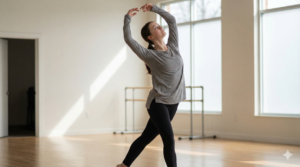
Contemporary dance is a dance style that focuses on expression, fluid body movement, emotion, storytelling, and creative freedom. It often mixes elements from different styles, especially ballet, modern dance, and natural movement.
Instead of following only fixed steps, contemporary dance often allows the dancer to explore feeling, space, rhythm, and intention. That is why two contemporary performances can look completely different from each other.
In simple words, I would describe contemporary dance like this: it is a style where technique and emotion work together.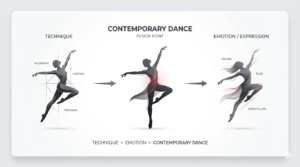
Sometimes it looks soft and flowing. Sometimes it looks sharp, grounded, or even abstract. The goal is not just to “do steps correctly.” The goal is also to communicate something through movement.
What Makes Contemporary Dance Different?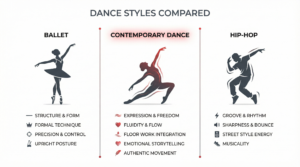
It is more expressive than many structured styles
In ballet, the technique is highly codified. In hip-hop, groove, musicality, and style vocabulary are central. In contemporary dance, expression often becomes the heart of the performance.
That means I am not only learning how to move. I am also learning why I am moving that way.
It blends technique with freedom
Contemporary dance style usually includes training, but it also gives room for interpretation. A dancer may use choreography, but they may also use improvisation to explore emotions, shapes, and transitions.
It often uses the floor and gravity
One thing that makes contemporary dance techniques stand out is the way dancers work with the floor. Unlike styles that stay mostly upright, contemporary often includes rolling, falling, recovering, sliding, and grounded movement.
It values authenticity
Contemporary dance does not always ask me to look perfect. It asks me to look real, connected, and present. That is one reason many beginners find it meaningful.
Common Elements of Contemporary Dance
Body movement and flow
Contemporary dance often uses the full body in a connected way. The arms, spine, torso, head, and legs all work together rather than moving in isolation.
Rhythm and expression
The movement does not always match music in an obvious way. Sometimes the rhythm is smooth and musical. Sometimes it is off-beat, silent, or emotional. Expression matters as much as timing.
Choreography and storytelling
A lot of contemporary pieces use choreography to show an idea, emotion, or internal journey. Even when there is no direct story, there is often meaning behind the movement.
Improvisation
Improvisation is a big part of dance training in this style. It helps dancers respond naturally, discover their own movement quality, and build confidence.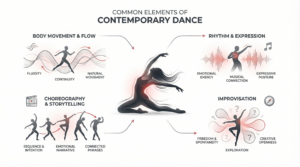
Basic Contemporary Dance Techniques Beginners Should Know
Posture and alignment
Before anything else, I need to learn how to stand, shift weight, and move with awareness. Good alignment helps me dance safely and with better control.
Breath connection
Breath is not just for fitness. In contemporary dance, breath often supports movement quality. A movement can feel softer, deeper, or more emotional when breath is involved.
Floor work
This includes moving on and through the floor with control. At first, floor work may seem difficult, but it becomes easier with practice and guidance.
Balance and weight transfer
Many beginner dancers struggle because they focus only on copying steps. In reality, contemporary dance for beginners becomes easier when I understand how to shift my body weight properly.
Control and release
Contemporary movement often plays with tension and softness. One moment may require strength, and the next may require complete release.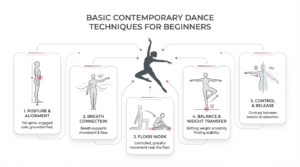
Can Beginners Learn Contemporary Dance?
Yes, absolutely.
I do not need to be highly flexible, advanced, or professionally trained to begin. What I really need is body awareness, patience, openness, and consistency.
Many beginners assume contemporary dance is only for highly trained performers because it looks artistic and emotional. But that is not true. In fact, this style can be a great starting point for someone who wants to connect movement with feeling instead of only memorizing flashy steps.
What matters most is the learning environment. A beginner-friendly class can introduce the basics slowly and help me understand movement quality without pressure.
How I Would Start Contemporary Dance as a Beginner
1. Learn the foundation first
I would begin with a basic class that teaches posture, alignment, body control, and simple movement patterns. I would not rush into advanced choreography too early.
2. Observe before judging myself
When I start, I may feel awkward. That is normal. Contemporary dance can feel unfamiliar because the movement is different from everyday posture. I would focus on learning, not comparing.
3. Build strength and mobility gradually
I do not need extreme flexibility on day one. But improving mobility, balance, and core strength will help a lot over time.
4. Practice expression, not just steps
A beginner mistake is trying to copy shapes without feeling them. I would try to understand the intention behind the movement. That is where contemporary dance becomes powerful.
5. Stay consistent
Even two or three focused practice sessions a week can create visible progress. In dance training, consistency matters more than perfection.
A simple first step
If I want to know how to start contemporary dance, the best first step is this: join one beginner class or follow one trusted beginner lesson and spend a week just understanding the basics of movement and flow.
Conclusion
Contemporary dance is more than a style I watch from a distance. It is a powerful form of movement that combines technique, emotion, freedom, and expression in a very human way.
If I have been confused about the contemporary dance meaning, I hope this has made it clearer. I do not need to know everything before starting. I just need curiosity, a willingness to learn, and the courage to begin as I am.
For any beginner, the journey starts with one simple decision: stop overthinking the style and start experiencing it through movement